Direct Instruction:
A Transactional Model*
Citation: Huitt, W. (2008). Direct instruction: A
transactional model. Educational Psychology Interactive. Valdosta, GA:
Valdosta State University. Retrieved [date], from
http://www.edpsycinteractive.org/topics/instruct/instevnt.html
Return to |
Designing Direct
Instruction | Overview of
Instruction | EdPsyc Interactive: Courses |
There are a variety of models of instruction that
have been derived from different theories of learning. These different models
identify different desired learning outcomes and propose different instructional
practices. Research shows that one approach to instruction, called direct or
explicit instruction (Rosenshine, 1995), generally produces better scores on
standardized tests of basic skills than do other approaches. Models based on
this approach are based on a combination of
operant conditioning and information
processing learning theories. Most models of
direct instruction focus on expected teacher behavior. The primary purpose
of the transactional model described below is to focus on the repeated
interaction of teachers and students throughout the lesson. This is based on
research showing that increased teacher/student interaction is correlated with
increased student achievement (Rosenshine, 1971).
|
Event |
Teacher Behavior |
Student
Behavior |
| PRESENTATION |
| Overview
|
- provides an opportunity for students to recall
and/or examine what they have already learned in
preparation for the current lesson
|
- focus on prerequisite skills and concepts
- check homework and discuss difficult questions
- link the lesson to previous ones
- work a problem similar to those done already
- review the previous lesson -- explaining what
they did and why
|
| Overview
|
- presents the specific concept(s) and skill(s) to
be learned
|
- read a stated objective for the lesson
- hear what the topic of the lesson is
- see what they will be able to do at the end of a
lesson
|
| Overview
|
- states a reason or a need for learning the
skill(s) or concept(s)
|
- see how the lesson is related to the real world
relate the lesson to their own interests
- discuss how the skill or concept can be applied
to other subject areas
- see how the lesson relates to their deficiencies
|
| Explanation |
- develops or explains the concepts and skills to
be learned
|
- hear an explanation
- use manipulative materials to develop concepts
and/or skills
- have class discussions
- see concrete examples
- watch films or filmstrips
- read explanations in textbooks
- interact with Computer Assisted Instruction
program
|
|
Probe & Respond |
- probes students as to their initial understanding
of concepts and skills
|
- answer teacher questions
- verbalize understandings
- model demonstrated processes
- generate examples and non-examples of a concept
|
| PRACTICE |
| Guided
Practice |
- closely supervises the students as they begin to
develop increased proficiency by completing one
or two short tasks at a time
|
- read a paragraph aloud in a reading group
- complete one or two math problems in an
assignment, while the teacher monitors their work
- complete an activity on the board, while others
do the same
- activity at their seats, and the teacher monitors
the work
- use structural analysis skills to orally decode
new vocabulary words
|
| Independent
Practice |
- allows students to work independently, with
little or no teacher interaction, to reinforce
individual proficiency with concepts and skills
|
- complete seatwork assignments
- drill on basic arithmetic facts
- begin or complete homework assignments
- play games related to specific skills or concepts
|
| Periodic
Review |
- provides students opportunity to have distributed
practice on previously covered content and skills
|
- demonstrate retention of previously learned
concepts and skills
|
| ASSESSMENT AND EVALUATION |
Formative
(Daily
Success) |
- checks students work each day and offers
corrective instruction as necessary
|
- complete independent work at or above a given
level of proficiency
|
Summative
(Mastery) |
- checks students work at the end of each unit of
instruction
|
- demonstrate knowledge and application of concepts
and skills at or above a given level of
proficiency
|
MONITORING AND FEEDBACK
(Provided throughout the lesson as needed) |
| Cues and Prompts |
- provides students with signals and reminders
designed to sustain the learning activity and to
hold students accountable
|
- attend to signals and/or reminders continue
working on assigned activity
|
| Corrective Feedback |
- tells students whether their answers are correct,
see or hear the correct answers, and are told why
those answers are correct
|
- read correct answers aloud
- write correct solutions to math problems on board
- check spelling by comparing their answers to
those on a transparency
- support their answers to reading comprehension
questions by reading aloud from the text
|
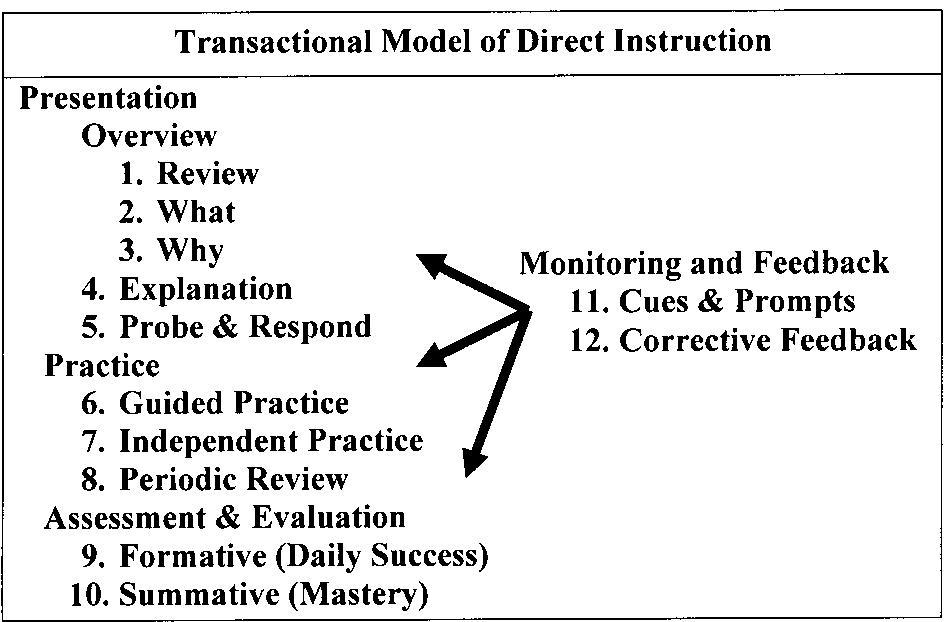
Putting this all together the model looks like this:
References
- Rosenshine, B. (1971). Teaching behaviors and student
achievement. London: National Foundation for Educational Research in
England and Wales.
- Rosenshine, B. (1995). Advances in research on instruction.
The Journal of
Educational Research, 88(5), 262-268.
* Material adapted from: Caldwell, J.,
Huitt, W., & French, V. (1981). Research-based classroom
modifications for improving student engaged time. In D. Helms, A. Graeber, J. Caldwell, & W. Huitt (Eds.). Leader's guide
for student engaged time. Philadelphia: Research for Better
Schools, Inc.
| Internet Resources |
Electronic Files |
Return to:
All materials on this website
[http://www.edpsycinteractive.org] are, unless otherwise stated, the property of
William G. Huitt. Copyright and other intellectual property laws protect these
materials. Reproduction or retransmission of the materials, in whole or in part,
in any manner, without the prior written consent of the copyright holder, is a
violation of copyright law.